
No one sets out to make a bad movie.
No one sets out to make a classic movie.
Somewhere during development, filming, editing and marketing a film can go either way. In theater there are dozens of people behind the scenes, in film it’s thousands. Sometimes, in the collaborative art of filmmaking, those thousands of people create a legendary classic!
Co-Director Rob Minkoff recalls the original pitch to Disney CEO Michael Eisner.
“I heard a story about the original pitch. Charlie Fink, then head of creative development, pitched the concept to Michael Eisner as “Bambi in Africa.” Michael’s response was, “If you can find a way for the lions not to eat Bambi, it may work.”
Originally The Lion King was titled King of the Jungle, and the approach was far more naturalistic. The title changed when writers realized that lions didn’t live in the jungle, and the approach changed as writers struggled to bring a mythic spirituality to the story.
Linda Wolverton, one of three credited screenwriters, recalls that Joseph’s Campbell’s book The Hero with a Thousand Faces was required reading at the studio after it influenced George Lucas so significantly in Star Wars.
“They had this summary by Chris Vogler because no one was going to read the whole book. So, I went home and I wrote him a memo, which I actually still have, about analyzing our story according to the hero’s journey and this is when I went off onto Hamlet and I basically said, “It is at this point that we veer out of hero’s journey and really move into Shakespeare territory.”
Rob Minkoff recalls the next pitch to the Disney executives.
The first thing our producer, Don Hahn, did once Roger [Allers] and I became [directing] partners, was to convene a small group to rework the story…which included all the major new set pieces—including Circle of Life, the Elephant Graveyard, Stampede, Simba’s Exile, Timon and Pumbaa as outcasts, Mufasa’s Ghost, and Simba’s return to Pride Rock.
As we finished the pitch, Eisner asked if we could use Shakespeare, specifically King Lear, as a model to ground the material. But it was Maureen Donnelly, producer of The Little Mermaid, who suggested Hamlet was more appropriate.
“The uncle murders the king… of course!” “It’s Hamlet with Lions!” Michael declared and that was that.”
I find it amazing how thousands of people can come together and create a classic that has such emotional impact, it really is movie magic! Linda Wolverton recalls the moment when she knew they had created something special.
“At Radio City Music Hall you could feel it…I heard the people crying. This was the first time I had seen it with an audience…and when I heard the people sniffling, I went, “Oh, yeah, we got em’. It definitely struck a chord in humankind. I was in South Africa three or four years ago and once people heard that I had contributed to The Lion King, they would cry.”
Disney’s The Lion King JR. Set Design
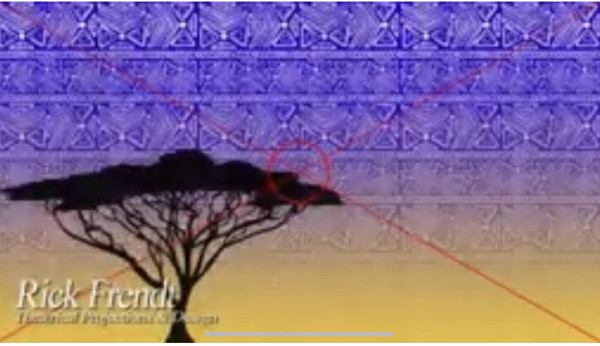
Director Katie Smith and I had to make an early decision on the overall style for the production. There were two ways to go, a more cartoony version like the film or a more stylized version like the Broadway show. We even had two different options for projected scenery that reflected those choices. We were happy with the Rick Frendt projections for Newsies JR. and we decided to use his projections again. His digital designs made extensive use of African fabric patterns which will also be reflected in the sets, lighting and costuming.
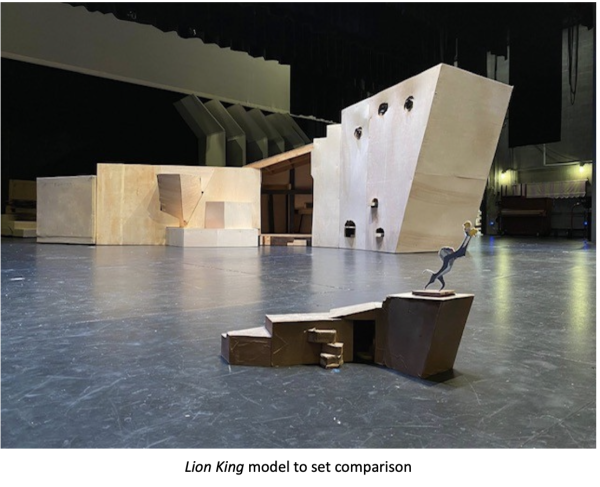
Pride Rock would be the most important element to the set and I began my design there. I was thinking of a set piece about four to five feet tall at the most. But as Katie and I talked about ideas for the set she said, “I’ve got some tall kids in the cast, they can’t be taller than Pride Rock!” Pride Rock is now built and is seven feet tall!
I’m getting ahead of myself.
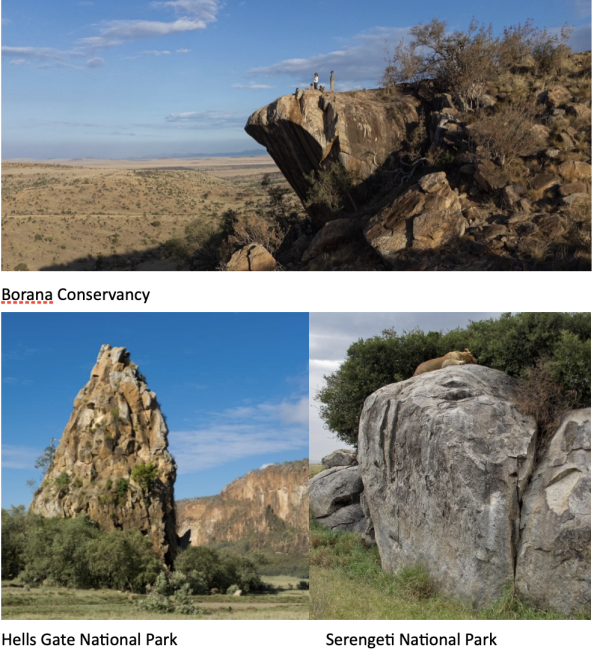
I like to conduct research for my set designs, and I found that at least three different locations claim to have the “real” Pride Rock! While reading about the origins of the film I learned that Disney animaters had visited Kenya’s Hells Gate National Park for their research, but I was more inspired by a formation in the Borana Conservancy, also in Kenya.
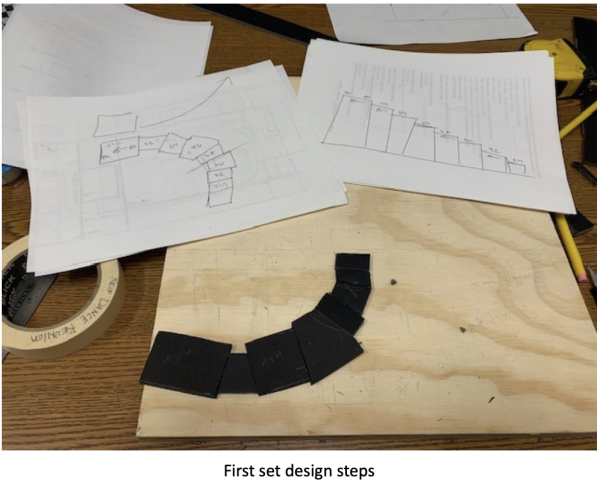
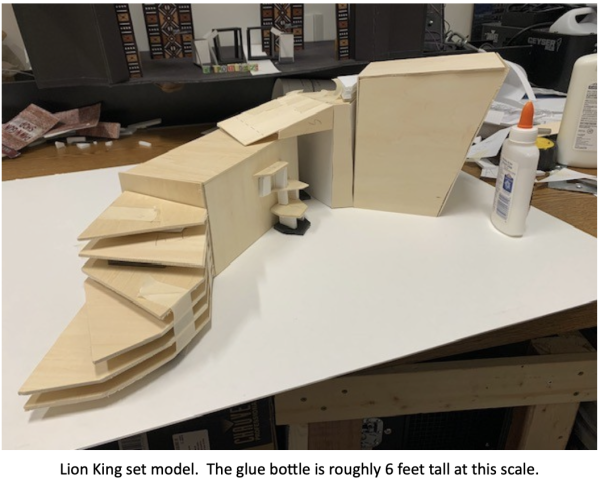
The hardest part about a seven-foot-tall set piece is how to get actors on and off. Even with our stylistic design we can’t have a staircase to the top of Pride Rock! I began playing with some sketches and foam-core to play with the levels and shape of Pride Rock.
This summer we updated our inventory of stock platforms, so I began looking at that list. I found a couple of odd shaped platforms that could work, along with an already built ramp. We try to reuse existing platforms to save time and money.
Frequent readers already know that I love making models of my set designs and this would be my next step!
Something Katie wanted was different ways for cast members to climb up Pride Rock, without using the curved steps. As I built the model a couple of spots presented themselves as good locations for those. I also thought of adding rock wall climbing grips to the sides of Pride Rock. Another change that came about in the model was an opening underneath the ramp that we might use in Scar’s cave.
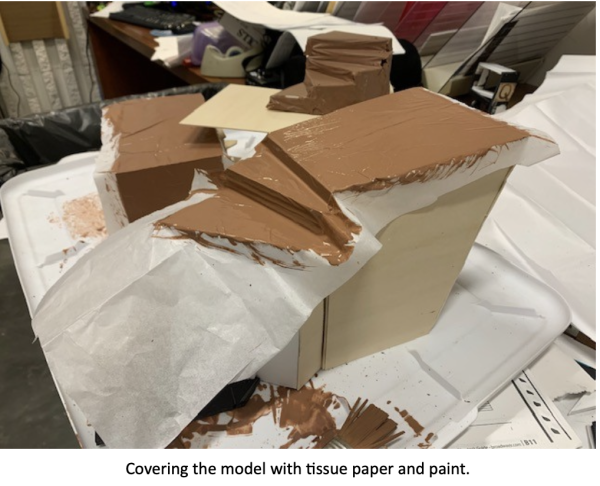
I primarily used wood instead of foam-core board, which is unusual for me. I thought the wood would hold together better in the final step where I covered the model with tissue paper and paint. It made the model look more complete, and it mimicked the process we eventually used to cover the full-sized set. To protect the actor’s feet and hands from splinters we covered Pride Rock with muslin. As a bonus the muslin covers the occasional seams and gaps in the construction!
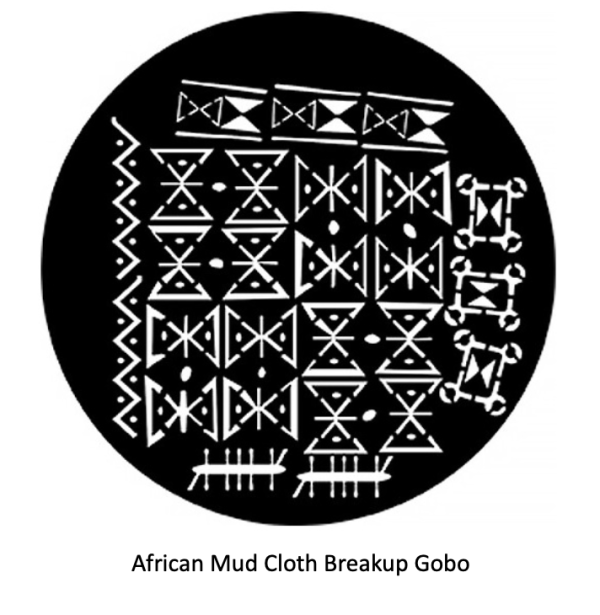
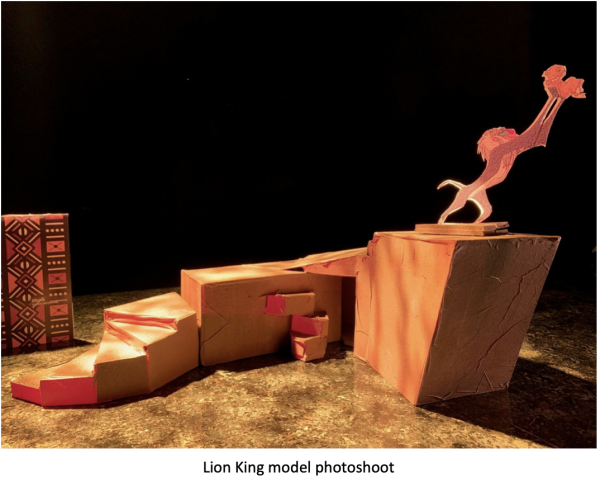
After the model was completed, I put together some stage lights to see the impact of different colors and lighting angles. I wanted some pretty pictures, but the photo shoot helped generate some ideas for my lighting design. I can already tell that ambers, reds and gobo backlighting will be featured, I even ordered some new gobos!
I can’t wait to see the sets, puppets, costumes and lights come together with our amazing cast and crew. The Lion King JR. will remind you of everything you love about the film, but with the extra magic of live theater! Don’t miss it, get your tickets now, I can almost guarantee it will sell out!