
In is down, down is front
Out is up, up is back
Off is out, on is in
And of course –
Left is right and right is left
A drop shouldn’t and a
Block and fall does neither
A prop doesn’t and
A cove has no water
Tripping is OK
A running crew rarely gets anywhere
A purchase line buys you nothing
A trap will not catch anything
A gridiron has nothing to do with football
Strike is work (In fact a lot of work)
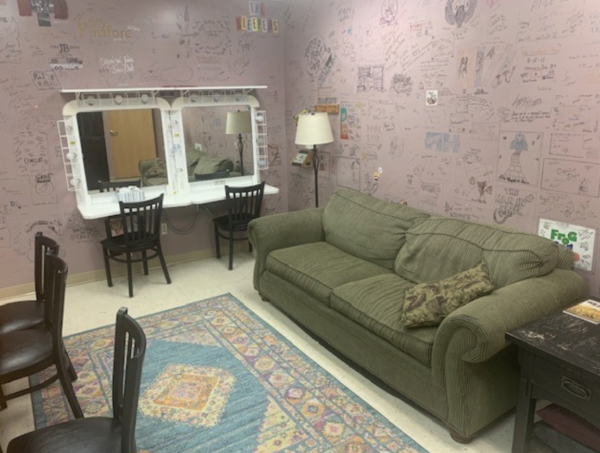
And a green room, thank god, usually isn’t
Now that you’re fully versed in Theatrical terms,
Break a leg.
But not really.
~ Author unknown
Are you confused? Don’t be, the world of theater has its own language and logic that often baffles the uninitiated. This is encapsulated perfectly in the nonsense poem, “Theatrical Logic”. Let me guide you through the “logic” of this poem!
In is down, down is front
Out is up, up is back
In and out is the movement of the fly system whereby fly in (down) and fly out (up) scenery and backdrops.
Beginning in the Middle Ages, many English theaters had a raked, or slanted, stage floor. For an audience seated on a flat floor, it improved their ability to see and hear the actors. Literally as you came to the front of the stage, you walked downhill and walked uphill to go to the back of the stage!

Off is out, on is in
And of course –
Left is right and right is left
Continuing with stage directions, if you go offstage you are exiting the stage or going out. Coming onstage you are entering the stage or coming in.
Stage directions are given from the perspective of an actor on stage looking at the audience. Thus, when an actor exits stage right, it’s the left from the audience’s perspective.
Surprisingly the written use of “stage right” and “stage left” only began in 1931, I don’t know how the poor stage managers kept track of the actors before that!
A drop shouldn’t and a
Block and fall does neither
Regular readers will know that a drop is a painted scenery backdrop, and having it literally drop would be a very bad thing!
Block and fall is another somewhat antiquated reference to the fly system, where blocks are pulleys and falls are the rope that runs through the pulleys.
A prop doesn’t and
A cove has no water
Props are objects handled by the actors. A glass, torch, gun or suitcase are all examples of props. I suppose if you have a prop walking cane then you would have a prop that props!
A cove is a lighting position in the auditorium that is somewhat hidden from the audiences view, and we certainly don’t want any water in it! I learned long ago that water and electricity don’t go together! I haven’t heard “cove” used often lately, modern theater architecture tend to leave lighting positions in the auditorium open and exposed.
Tripping is OK
A running crew rarely gets anywhere
I would never trip someone, but in the theater it is ok to trip a drop! Before the Reif Center renovation in 2015-2016 we had a very short fly loft over the stage. It was difficult to use rented backdrops because they could only fly out 8 feet over the stage!
One way to solve this problem is to “trip” the drop, so that it only takes half of its full height to store. First you fly out the backdrop as far as you can. Then, a 2nd batten (pipe) lifts the bottom of the drop so that the drop doubles up on itself.
Running crew is simply the stage crew needed for operations during the production’s performance, as opposed to a loading crew. When we have a big show come to the Reif Center we may need 20 or more load in and load out crew, but maybe only 5 running crew during the performance itself. Running crew includes the crew for moving and flying scenery, operating sound, lights and follow spots, and costumers helping with backstage quick changes.

A purchase line buys you nothing
A trap will not catch anything
Purchase line is another term used in the fly system. It is the rope that connects to the counter balance that the fly operator pulls on to raise or lower stage scenery.
Did you know the Reif Center has traps! And not just to catch the mice we sometimes have. We don’t use them often but we have two 4 foot x 8 foot sections of the stage that can be removed to create an opening in the stage floor. You may have a set design that calls for a cellar below the floor or you want to melt the wicked witch in Wizard of OZ! “Trap” also lends its name to the area below the stage, a trap room.
A gridiron has nothing to do with football
Strike is work (In fact a lot of work)
The Reif Center does not actually have a gridiron! Typically a gridiron is high over the stage and allows access to the wires and pulleys of the fly system over the stage. This would be a “walk on” grid, you can easily move around on it. This allows you to rig extra drop points over the stage for touring shows.
In the Reif the fly system is connected directly to the roof beams. Our personnel lift will not reach the roof over the stage, making it impossible to add additional drop points for our touring shows. But, we anticipated this during the renovation and installed 30 “drop points” over the stage. These points are high enough to remain hidden from view, but low enough for crew to reach with our personnel lift. Whenever you see a touring show at the Reif Center using overhead lighting trusses we are making use of our drop point system!
When the crew strikes, they are not joining a picket line (usually). Strike happens when the performance is over and the crew removes all the sets and equipment for the production. For out Theater Arts youth productions, strike means breaking down the set, putting away props and costumes and cleaning the dressing rooms. As you can imagine this is a lot of work, and often the entire cast will stay at the close of a show to help the crew!

And a green room, thank god, usually isn’t
Now that you’re fully versed in Theatrical terms,
Break a leg.
But not really.
The green room is where the performers can relax before the performance. The Reif green room has a fridge and a comfortable couch and will have snacks and drinks available for the cast and crew. Our green room is actually more of a mauve, with the walls covered with signatures of previous artists!
Why is it called a green room? I was told long ago it was because of the use of calcium oxide, or limelight, in early theatrical lighting. But limelight wasn’t used until 1820 and the use of the term “green room” dates back to the 1600’s.
The oldest and simplest theory is that London’s Blackfriars Theater had a room backstage where the actors waited and it happened to be painted green, and eventually came to refer to the room and not just the color.
Oh, and break a leg? This might get complicated, there are many popular theories! This is just one possibility.
The German phrase Hals-und Beinbruch literally means “neck and leg break”. There is a Yiddish phrase, Hatsloche un Broche, with a very similar pronunciation, which means “success and blessing.” At some point, Hals-und Beinbruch began to be used as a humorous pun to wish someone “good luck”.
A 1921 article, “A Defense of Superstition”, states that in the world of horse racing to wish someone good luck was considered unlucky, so you should say something insulting like, “May you break your leg!”
Possibly German speaking Jewish immigrants brought the superstition and the phrase to England and America after World War I. The earliest published reference to “break a leg” in a theatrical context dates from 1939.
I hope you enjoyed this journey through theater logic! Feel free to impress friends and family with your newfound knowledge!